Edition 016: Data is Power
Joseph Stiglitz, George Akerlof, and Michael Spence shared the Nobel Prize in 2001 for showing that markets with asymmetric information — where one party knows more than the other — do not work the way the textbooks say… You knew more about your own creditworthiness than the bank deciding whether to lend to you. You knew more about your own health than the insurance company selling you a policy… That sliver was, in a modest but real way, a form of power…
The data economy ended that. And it did not just end it. It reversed it.
The platform you use every day now knows more about you than you can reliably reconstruct from memory… It knows what makes you anxious. It knows what makes you click… The employer knows more about what workers like you will accept than you know about what you are worth…
It used to be that an insurer did not know which member of the pool would get sick, or crash, or lose the house. The insured members did not know either. Because no one knew, the cost of the events was spread across everyone… What the industry is selling now, under the legal protection that was built for insurance, is not insurance…
The people with the most data have the most power…
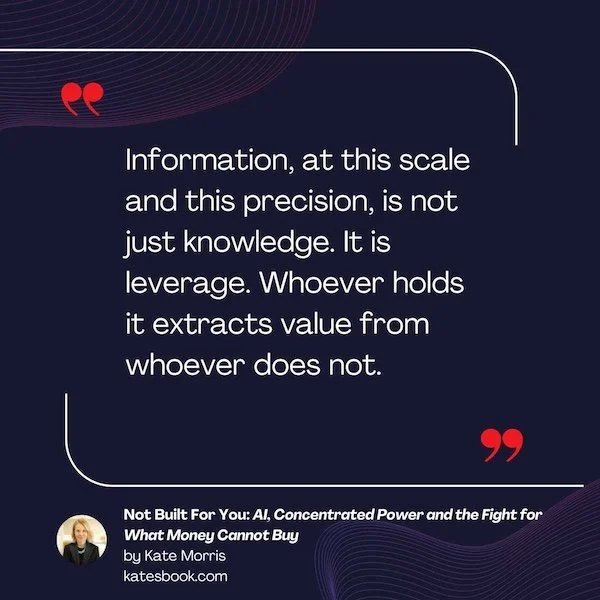
And information, at this scale and this precision, is not just knowledge. It is leverage.
Edition 013: The Taking of Human Data
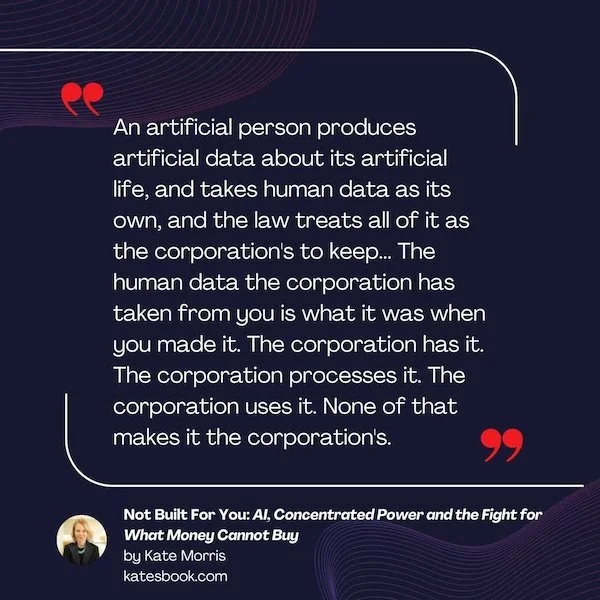
The corporation is a person the law invented so that capital could be pooled and risk could be shared. It is an artificial person under the law, and what it produces is what I want to call artificial data... An artificial person produces artificial data about its artificial life, and takes human data as its own, and the law treats all of it as the corporation's to keep.
Nothing in that chain reaches into a human being. And nothing in that chain works in reverse. The corporation cannot turn human data into artificial data by collecting it... The human data the corporation has taken from you is what it was when you made it. The corporation has it. The corporation processes it. The corporation uses it. None of that makes it the corporation's.