Epilogue
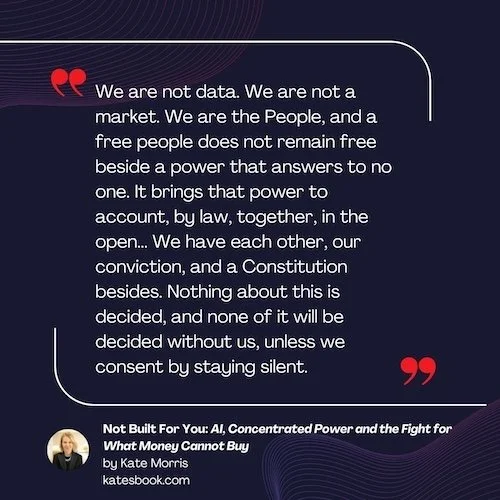
I did not say exactly what I meant. So let me say it now. The danger of AI was never the technology. It is the power the technology inherited... We were not participants. We were inputs... We are the People... This is the fight for what money cannot buy. It is our fight for each other, and for our freedom. And it has already begun

Edition 026: Seeing Each Other – The Conclusion
The conclusion of Not Built for You remembers Charles Hosch, the finest lawyer and person the author knew — a vir modestus who lived as though the purpose of a life is service. Through his story of a drifter repaying kindness on a Vietnam tarmac, it argues we've built systems that cannot look up... The work is to see each other, listen, and find balance.
Edition 025: When the Structure is Changed
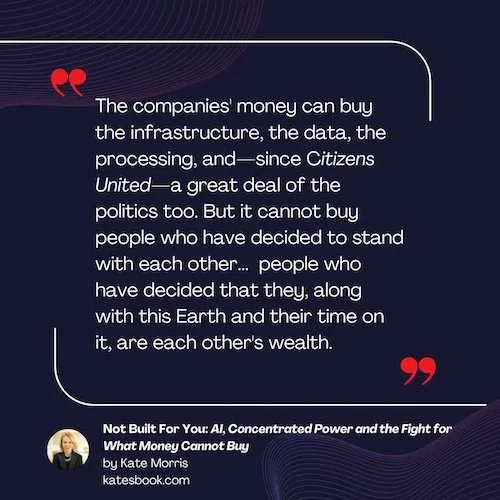
When the Structure is Changed: The companies that own almost everything hold a power no single town can meet—only the federal government is built to their scale. So who governs AI decides whether that counterweight gets used. Government follows incentives, and money moves them... but so do people acting together, and money cannot buy people who have decided they are each other's wealth.
Edition 024: The Bargain
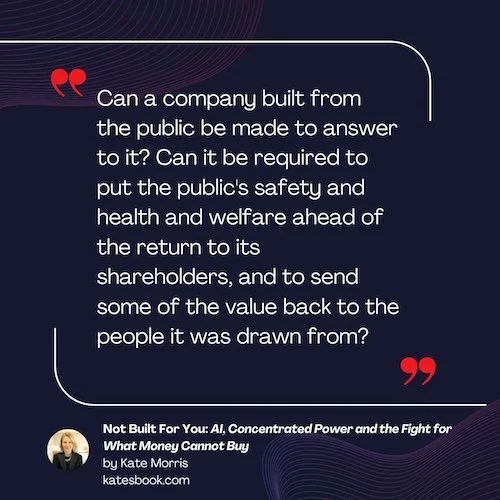
We have always governed power by striking a bargain. When we let a few hands hold something everyone depends on, the water, the grid, the rail line, we have asked something of them in return... These companies have taken our human data and built their systems from us. I do not see yet what they have given back... These are the questions, and the answers are owed by us, not to us.
Edition 023: This Belongs to Everyone
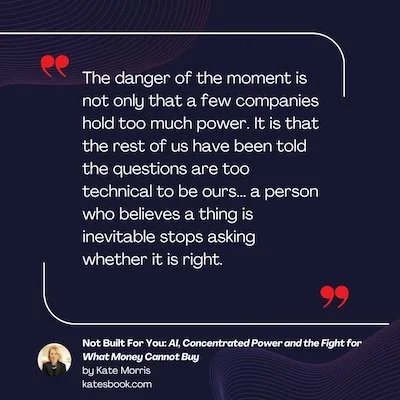
I do not have the answers... No one can, alone. When Pope Leo wrote his encyclical on artificial intelligence this spring, the part that stayed with me was the insistence that the work of governing these technologies belongs to everyone... The questions worth asking are questions about what we owe each other, and those have never belonged to specialists.
Edition 022: The Franchise of the Soul
Edition 022 of Not Built For You glosses the cultural diagnostic I could not finish and answers the question underneath it: We built the world that steps on the small thing without noticing. The franchise, the feed, the transaction... a culture that prices everything loses the practices that hold people to each other. What is left is sameness, the self, and the wish for more.
Edition 021: The Doodlebug
Edition 021: The Doodlebug... A system that prices everything decides what your inner life is worth too. The parts that can be measured and sold are valued. The parts that cannot are treated as though they were not there. A doodlebug was alive and going somewhere, and my inattention ended it. Are we building a world that can feel the weight of a life it has no use for, or one that steps on us without noticing?
Edition 020: The Judgment
Edition 020 pivots from the book's analysis of systems to the culture underneath them. Pope Leo's AI encyclical named the belief the book has been tracing: A person's value does not depend on what they produce. A culture that cannot grant the full weight of a life to the people its systems are built from has revealed what it was never able to see. The rebuttal worried about fairness to the machine, not the people it discards.
Edition 019: The Debasement
Edition 019 is about the money. Data and money are the two resources the economy runs on, and both are taken from the people who produce them and concentrated where power already sits. The dollar is debased, the people who hold assets stay whole, and everyone else absorbs the loss. AI is offered as the way out, but it is unlikely to be a free, infinite money tree.
Edition 018: Risk
Insurance is the institution that, more than any other in the American economy, is supposed to quantify what it believes a harm is worth. The insurance industry has looked at generative AI and thrown up its hands... When that institution declines, that is the assessment. The risk is uninsurable, which is the industry’s word for too much.
Edition 017: The Cost
The cost of the data economy is not only the loss of autonomy and power that previous editions have described. It is also more systemic, involving the land, water, energy, and labor taken from places and people without the power to refuse... The system was built to see certain things and to be blind to others. What it sees, it counts. What it does not see, it does not owe... Texas is an example of that pattern. The state is on pace to host the largest concentration of data center capacity in the world by 2030... Texas has the highest uninsured rate in the country, for adults and for children... One in five Texas children, roughly 1.7 million of them, lives in a household that cannot reliably afford enough food... The extraction continues. From the extraction of human data to the extraction of human labor to the extraction of the earth itself, the cost is being borne by places and people without the power to refuse it. What the state counts as a boom is what the people inside it are paying for.
Edition 016: Data is Power
Joseph Stiglitz, George Akerlof, and Michael Spence shared the Nobel Prize in 2001 for showing that markets with asymmetric information — where one party knows more than the other — do not work the way the textbooks say… You knew more about your own creditworthiness than the bank deciding whether to lend to you. You knew more about your own health than the insurance company selling you a policy… That sliver was, in a modest but real way, a form of power…
The data economy ended that. And it did not just end it. It reversed it.
The platform you use every day now knows more about you than you can reliably reconstruct from memory… It knows what makes you anxious. It knows what makes you click… The employer knows more about what workers like you will accept than you know about what you are worth…
It used to be that an insurer did not know which member of the pool would get sick, or crash, or lose the house. The insured members did not know either. Because no one knew, the cost of the events was spread across everyone… What the industry is selling now, under the legal protection that was built for insurance, is not insurance…
The people with the most data have the most power…
And information, at this scale and this precision, is not just knowledge. It is leverage.
Edition 015: The Choice Was Made For You
The thing the corporation is taking is not just your human data… It is your ability to choose what happens next… By the time you are choosing, the choice has already been made smaller by a system you cannot see… There is no federal law requiring data brokers to tell you they have your file. You have no right to see it, correct it, delete it, or opt out of its sale… agencies that would need a warrant to get the same information directly… can purchase it from data brokers instead… This is what the loss of autonomy looks like. It's not a dramatic moment in which something is taken from you. It is a quiet narrowing of the world that reaches you… The corporations are not pumping your data to store it. They are extracting it to build a model of you, precise, predictive, and constantly updated, that gives the corporation an information advantage over you in every transaction you will ever conduct with it.
Edition 014: The Framework Convicts Itself
The view goes like this. The mind is a kind of information processing system. The brain is the machinery that does the processing. . . . Ilya Sutskever, the then co-founder and chief scientist of OpenAI, gave a TED talk in October 2023 in which he summarized the entire framework in one line. "AI," he said, "is nothing but digital brains inside large computers." . . .
Our argument is not that the framework is right. Our argument is that even if it is right, the corporation cannot use the framework to escape what it has done. . . . On the industry's own terms, their taking is the taking of a person.
. . . This is the same defense that was run when the cells were Henrietta Lacks's. The cells were biological material. The person was somewhere else. The material could be owned. The person could not. . . .
The AI industry's framework does not permit that distinction. If the pattern is the person, then the cells were never just material, and the human data is not just exhaust. . . . The taking of the cells was the taking of a person. The taking of the human data is the same taking.
Edition 013: The Taking of Human Data
The corporation is a person the law invented so that capital could be pooled and risk could be shared. It is an artificial person under the law, and what it produces is what I want to call artificial data... An artificial person produces artificial data about its artificial life, and takes human data as its own, and the law treats all of it as the corporation's to keep.
Nothing in that chain reaches into a human being. And nothing in that chain works in reverse. The corporation cannot turn human data into artificial data by collecting it... The human data the corporation has taken from you is what it was when you made it. The corporation has it. The corporation processes it. The corporation uses it. None of that makes it the corporation's.
Edition 012: Data as a Fiction
I think data is the fourth fictitious commodity. The market treats it as a product. The consequences fall on the people who produce it by being alive ... I disagree. Data is neither capital, nor a commodity. It is not something a corporation makes. It is something you make, by living ... The law currently divides what comes from a person into categories ... The categories were drawn by people who benefited from drawing them ... I watched part of the categorizing of data happen. Earlier in my career, many talented lawyers I knew flocked to the 'new' field of data privacy. My law partner, Charles, and I were doing something different ... The privacy field was not really about privacy. It was about compliance ... Privacy is what keeps the individual an individual at all ... The compliance industry did not protect that fence because the legislature did not ... A 'data subject' is what a person becomes when the framework gets through with them ... And this is what is legal and what is required. When I do data privacy work, this is what I do. This is what every lawyer does ... It was the orderly negotiation of how much of a person the corporation could take and still call itself compliant ... All of it is data. The immutable part and the lived part together are what a person is ... The fiction is in place. The category has been drawn. The framework has done its work. What it has not done is sever the thing the framework was built to take from the person it was taken from.
Edition 011: The Market as a Design Choice
When you fill your gas tank, buy groceries, look for a job, or scroll through your phone, you are participating in markets. We are all told that markets are efficient ... What we are not told is that the system was built on fictions. Not lies, exactly. Fictions. Things the system treats as true because it needs them to be true, even though they are not ... The market is a design choice. It was built by people, for purposes, under conditions, and it can be built differently ... Karl Polanyi, an economic historian writing in 1944 ... identified three things the market treats as ordinary products that are not products at all: land, labor and money ... Land was here before any of us. It doesn't truly belong to anyone. And yet the market treats it as a product ... Labor is human activity. It's your time. The hours of your life that you exchange for a paycheck ... Wage is not a reflection of what a human being is worth ... It is the minimum the market can get away with giving you depending on how desperate you are ... Money feels like the most obviously real thing in daily life — you either have it or you do not — but money itself is a fiction ... The winners are consistently the people who own the land, control the labor, and create the money. The losers are consistently the people who live on the land, sell the labor, and need the money. The fiction serves the transaction. The consequences fall on the people.
Edition 010: What Counts?— GDP, the Corporation, and the Materiality Standard
Every system decides what to count. That decision — which always looks like a technical choice — is also a decision about what to ignore. And a decision about what to ignore is, eventually, a decision about who the system can and cannot see ... Mississippi's GDP per capita is higher than France's, the United Kingdom's, and Italy's. By the number the world uses to measure prosperity, Mississippi outperforms some of the most developed nations in human history ... My step-grandparents lived in Forest, Mississippi. I lived in Paris. No number can make those places equivalent ... A corporation's moral compass, if it can be said to have one, points only at profit. In a person, we would call that greed. In a corporation, it is the law ... This is the system. It was built to count money and to serve the people who own it. It does that work with precision. Everyone else is invisible.
Edition 009: The Constitutional Choice Between Negative and Positive Rights
The people who sat down to write the German Basic Law had just lived through something the founders of the American republic had not. They had watched a modern, literate, and legally sophisticated state dismantle human dignity with bureaucratic precision, not despite the law, but through it. The Holocaust ran on the legal order. It was the machinery of the state, working as designed, and turned to the project of annihilating a people. Nothing in the framework existed that stopped it, because nothing required that.
That is what a legal order produces when nothing stands above the legislature. When the German Reichstag passed the Nuremberg Laws, they used those laws against Jewish citizens, taking their citizenship, their professions, their property, and their lives. The legal system did not break down. It did its work. What was missing was a constitutional floor of rights the legislature could not legislate away — a principle that said there were things the law could not do to a human being, no matter who passed it. That is the absence we are talking about.
Edition 008: The State Patchwork is Missing the Person
The United States has no federal AI law. In its absence, the states have produced a patchwork of more than a thousand bills and 145 enacted statutes, scattered across employment, healthcare, privacy, consumer protection, and a dozen other regulatory domains. This essay argues that the patchwork's deepest failure is not its incompleteness but its conception of the person. Each law recognizes the human being only in the market role its domain addresses — consumer, worker, renter, patient, parent, the citizen — and what these laws mostly require is notice rather than protection. Texas's TRAIGA demonstrates the pattern: it protects consumers but excludes workers, requires intent rather than reaching structural harm, and offers a safe harbor only well-resourced companies can use. Meanwhile, the most ambitious state law — Colorado's AI law— is under federal attack, with the Department of Justice framing civil rights accountability as ideology. The pattern reflects a constitutional tradition built around the right to be left alone by the government, not the right to be protected by it.